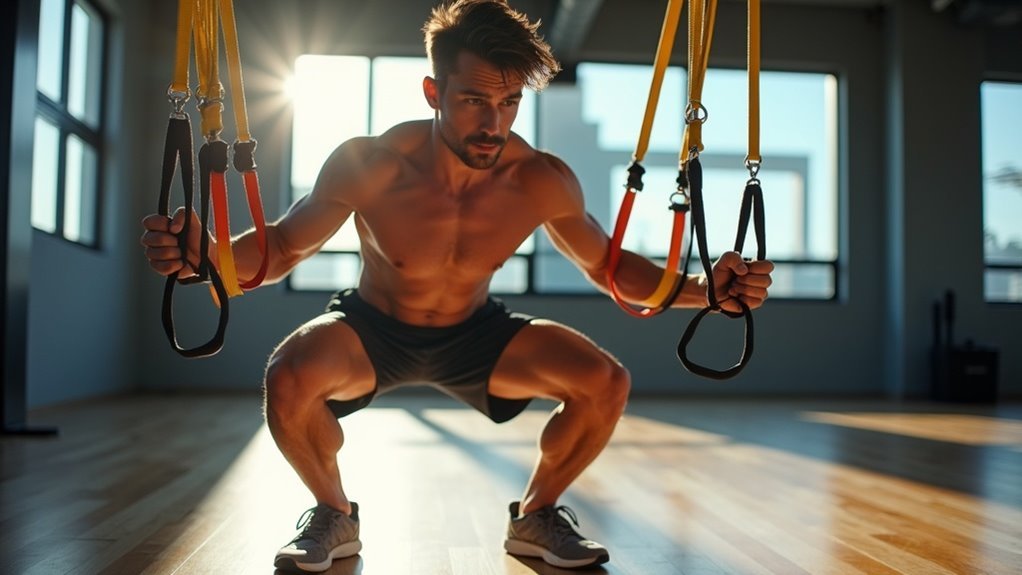
To effectively use bands for accommodating resistance in your home gym, securely anchor them to your equipment and choose exercises that are great for home workouts, such as squats, bench presses, and deadlifts. Make sure to adjust the band length and tension to match your strength level and specific fitness goals. Always verify your form to prevent injuries, and keep an eye on the wear and tear of the bands. To maximize strength development, incorporate varying tensions into your training routine. There’s a wealth of techniques and setups that can elevate your home workouts and help you stay healthy and fit.
Key Takeaways
- Securely anchor resistance bands to prevent slippage and ensure safety during your home workouts, checking for wear or damage regularly.
- Incorporate exercises like squats and bench presses to effectively utilize accommodating resistance, adjusting band length and thickness based on your individual fitness goals.
- Employ proper attachment methods, such as looping bands around barbell collars or anchoring them under benches, to achieve optimal tension during your at-home workouts.
- Maintain strict monitoring of your form to prevent injuries and ensure that the band tension aligns with your lifting technique and fitness aspirations.
- Integrate bands into your dynamic effort workouts, focusing on progressive overload and varying setups to enhance strength development over time, making the most of your home gym experience.
Understanding Accommodating Resistance
When you incorporate accommodating resistance into your home workout routine, you’re utilizing a powerful technique that modifies the resistance experienced during your lifts. By using resistance bands, you can create variable tension that increases as you reach the peak of your lift, effectively altering the strength curve.
This method challenges your muscles at specific joint angles, enhancing your rate of force development right from the comfort of your home gym.
Properly integrating accommodating resistance is crucial; relying too heavily on bands can potentially weaken your foundational lifts. However, by targeting specific weaknesses, accommodating resistance can lead to significant strength gains, making it an essential component of effective home strength training for both men and women at any fitness level.
Embrace this technique to elevate your home workouts and achieve your fitness goals!
Benefits of Using Bands in Training
Using bands in your home workout routine can significantly boost your explosive power by increasing the demand for quicker force application during lifts.
They enhance overall force production, helping you sustain maximum effort throughout your entire range of motion, whether you’re a beginner or an experienced athlete.
Furthermore, bands allow for targeted muscle activation, enabling you to address specific weaknesses and optimize your performance effectively from the comfort of your home gym.
This makes them an excellent addition for both men and women looking to improve their fitness and health.
Enhanced Explosive Power
Incorporating resistance bands into your home workout routine can significantly enhance your explosive power during training. By increasing resistance throughout the lift, bands encourage you to accelerate the barbell from start to finish, effectively targeting the muscles crucial for explosive movements.
Fitness enthusiasts emphasize the importance of bands for developing key muscle groups, such as the triceps during bench presses or the glutes during squats, which can elevate your overall performance.
Studies indicate that using bands can lead to greater strength and power gains compared to traditional weights alone. The dynamic effort method, which utilizes bands, is particularly effective for improving your rate of force development (RFD), a critical factor for maximizing explosive capability in various physical activities.
This method ensures you achieve peak force production right from the comfort of your home gym.
Improved Force Production
Explosive power is only part of the equation; improved force production is equally essential for anyone looking to boost their home workout performance.
By incorporating resistance bands into your training routine, especially during exercises like the bench press, you can significantly enhance your strength and force output.
Bands offer accommodating resistance, making the lockout phase more challenging, which encourages you to exert maximal force. This method not only improves your rate of force development (RFD) but also leads to greater strength gains over time.
Research indicates that combining bands with free weights yields better results than traditional weights-only workouts, ultimately enhancing your overall fitness and performance in your home gym.
Targeted Muscle Activation
Resistance bands are an essential addition to your home gym equipment, providing a unique way to enhance targeted muscle activation during your at-home workouts. By utilizing accommodating resistance, these bands require you to apply force quickly, maximizing engagement in key muscle areas. This method allows you to maintain peak force throughout your exercises, helping you avoid the typical slowdown often experienced with traditional strength training.
| Muscle Group | Exercise | Benefit |
|---|---|---|
| Triceps | Bench Press | Increased activation |
| Glutes | Squats | Enhanced engagement |
| Shoulders | Overhead Press | Improved stability |
Proper Setup for Bands in Exercises
To maximize the effectiveness of bands in your home workouts, it’s essential to understand proper attachment techniques and tension measurement methods.
Start by securely anchoring the bands to your home gym equipment, ensuring they’re in good condition to prevent injury.
Then, choose exercises that benefit from accommodating resistance, adjusting band length and thickness to align with your fitness goals.
This approach will help both men and women achieve optimal results while exercising at home.
Band Attachment Techniques
Properly securing bands is essential for effective and safe workouts at home.
To maximize the benefits of accommodating resistance training in your home gym, follow these band attachment techniques:
- Loop bands around the barbell collar, not the bar, to prevent damage and ensure longevity of your equipment.
- Anchor bands securely to avoid slippage during lifts, providing a safer workout experience.
- For squats, use a choked setup with bands looped around the barbell and under your feet to enhance band tension and improve your leg strength.
- During bench presses, place bands under a flat bench, holding the ends to create upward resistance, helping you build upper body strength effectively.
Tension Measurement Methods
When measuring band tension for effective home workouts, accurate assessment is essential to ensure you’re achieving the right resistance during each lift. Use a scale to measure band tension at lockout and at key joint angles to cover a full range of resistance training. Securely anchor the bands to maintain consistent resistance throughout your exercises. Adjust the band length or attachment height to customize the tension profile to fit your personal fitness needs.
| Setup Type | Band Tension |
|---|---|
| Single Band | Moderate Resistance |
| Double Bands | Increased Resistance |
| Quadrupled Bands | Maximum Resistance |
This method ensures you have the ideal accommodating resistance for your home gym workouts, helping you to stay healthy and fit from the comfort of your own space.
Exercise Selection Guidelines
Integrating resistance bands into your home exercise routine can significantly enhance your strength training, especially when set up correctly for each lift.
Here are some guidelines for incorporating bands into your workouts:
- Bench Press: Anchor bands under your bench to increase resistance as you push the barbell upward, making your chest workouts more challenging.
- Squat: Loop bands around your barbell and secure them to the floor to introduce variable resistance, which can help improve your squat strength.
- Deadlift: Attach bands to your barbell and anchor them under your feet to add resistance at the top of the lift, enhancing your overall deadlift performance.
- Monitor Form: Always prioritize proper technique, particularly if you’re a beginner, to prevent injuries and ensure effective workouts.
Key Exercises for Accommodating Resistance
To effectively utilize accommodating resistance in your home workouts, consider incorporating specific banded exercises into your training routine.
The Banded Barbell Hip Thrust is excellent for enhancing glute engagement, improving strength at the lockout phase and making it ideal for those looking to build strength from home.
For your upper body, the Banded Dumbbell Bench Press adds extra tension, boosting power and control throughout each lift, perfect for a home gym setup.
The Banded Kettlebell Sumo Deadlift challenges your posterior chain, promoting strength gains while keeping your workout varied and engaging.
By integrating bands into your routine, you’ll prevent lazy reps, ensuring you exert maximal force during each lift.
Many strength coaches recommend using bands for 1-2 exercises per body part per workout, helping you align your training with your goals of building strength and optimizing your range of motion, all from the comfort of your home.
Safety Considerations When Using Bands
While using bands can significantly enhance your home workouts, it’s crucial to prioritize safety to prevent injuries.
Here are some key considerations for both men and women:
- Regularly inspect your bands for any wear or damage to avoid potential safety risks during your exercises.
- Use the appropriate band tension that aligns with your strength level to ensure you maintain proper lifting technique and prevent strain.
- Always confirm that your bands are securely anchored to avoid slippage or snapping while you perform your lifts.
- Steer clear of using bands that are too thin or not specifically designed for your exercise, as they may not provide the necessary support for effective workouts.
Common Mistakes to Avoid
Using bands effectively in your home gym requires awareness of common mistakes that can hinder your progress.
One major mistake is improperly securing bands, which can create safety hazards during workouts. Always anchor your bands securely to avoid accidents.
Additionally, adjust band tension according to your strength level; failing to do so can lead to ineffective training sessions.
It’s essential to master fundamental lifts rather than overly relying on bands for accommodating resistance, as this can stall your long-term development.
Neglecting to monitor your form while using bands can result in poor movement patterns, which can be counterproductive.
Lastly, vary the types of bands you use to prevent adaptation and encourage continued strength gains in your home workout routine.
Integrating Bands Into Your Training Routine
Integrating bands into your home training routine can significantly boost your strength development when utilized effectively. Start by incorporating bands into your dynamic effort workouts, focusing on 20-25% of your training max.
Here are some practical ways to use bands effectively at home:
- Enhance multi-joint exercises like bench presses and squats to maximize your workouts.
- Experiment with setups, such as double loops for bench presses, to increase resistance.
- Progressively increase the complexity of your band exercises as you become more comfortable.
- Regularly monitor and adjust band tension to effectively target sticking points and improve your performance.
Using bands in your home gym can provide a versatile and effective way to enhance your fitness journey.